100–500 mg/L
Lightly mineralized
Enough minerals, without an overload of salts.

For practically every healthy person, everyday drinking water should meet a whole set of parameters at once. It’s their combination that makes water truly good.
No.
Water from any one source has a fixed mineral makeup: a little more calcium here, a little less magnesium there. Your body’s needs, meanwhile, keep changing — with your lifestyle and your physical, mental and emotional load. That’s why no single water suits everyone at every moment.
Still growing: needs minerals every day and enough water to stay alert and focused in class.
Workouts mean more water lost through sweat — and more to replace.
Even mild dehydration can lower concentration and make tasks feel harder.
Thirst fades with age, so she does best drinking on a schedule — and gentle water without excess salts.
Everyone’s needs are different — yet the water from the tap or the filter stays the same, day after day. That’s why it’s worth drinking water that isn’t just purified but balanced: lightly mineralized, with a negative ORP, rich in hydrogen and mildly alkaline — water that suits the whole family. Here are those four parameters ↓
Enough minerals, without an overload of salts.
An oxidation-reduction potential closer to that of the body’s own fluids.
Dissolved free H₂ — what researchers study as a selective antioxidant.
A gentle alkaline balance that’s pleasant to drink every day.
Benchmarks for everyday water from the book 5 Fundamental Postulations of Drinking Water by Prof. Oleh Pokotylo (Ternopil, 2021).
Mineralization is the amount of minerals and salts dissolved in a liter of water, measured in milligrams per liter (mg/L); on a water report, it’s listed as total dissolved solids (TDS). Water brings calcium, magnesium, potassium and other elements with it — and the World Health Organization notes that drinking water can contribute calcium and magnesium to the diet.
Water that’s too “empty” — distilled or reverse-osmosis water, far below 100 mg/L — is clean but carries almost no calcium or magnesium. If it’s your everyday water, your food has to supply those minerals on its own.
The other extreme is heavily mineralized water, above 1,000 mg/L — traditionally taken in courses rather than as everyday drinking water. For comparison, EPA’s non-enforceable guideline for total dissolved solids in tap water is 500 mg/L, set for taste and deposits rather than health.
For everyday drinking, Prof. Pokotylo’s benchmark is the middle ground: 100–500 mg/L. That’s enough minerals, without an overload of salts — water that works for the whole family every day, gently and without you noticing.
Checking is easy: look for TDS in your annual water quality report, or use an inexpensive handheld TDS meter for a rough reading in seconds. Water from a home reverse-osmosis system usually reads far below 100 mg/L.
pH is a scale of acidity from 0 to 14: anything below 7 is acidic, above 7 is alkaline. For reference, lemon juice is around pH 2, coffee around 5 and pure water 7 — while blood stays at about 7.35–7.45, slightly alkaline. The scale is logarithmic, so each whole number is a tenfold change.
That range is tightly controlled: the body keeps its internal pH steady on its own, with built-in buffering systems, whatever you eat or drink. Many everyday foods and drinks, from coffee to soda, are acidic, and that’s normal.
So alkaline water isn’t a way to “alkalize” your body. Mayo Clinic’s view is that for most people it isn’t better than plain water — and where naturally alkaline spring waters are praised, researchers credit their minerals, such as calcium and magnesium, rather than the pH.
What a mildly alkaline pH does offer is a softer taste that’s pleasant to drink every day. Higher isn’t automatically better, though: Mayo Clinic flags safety concerns especially above pH 9.8.
pH and hydrogen are separate measurements: water can be alkaline with virtually no dissolved H₂ at all. That’s why, beyond pH, it pays to check ORP and hydrogen.
Put simply, ORP — oxidation-reduction potential — is the “charge” of water. It’s measured in millivolts (mV) and can be positive or negative. A negative reading means the water tends to give up electrons (it reduces); a positive one means it tends to take them (it oxidizes).
Prof. Pokotylo writes that the body’s internal fluids — blood, lymph and the fluid inside and around cells — have a negative redox potential of roughly −70 to −200 mV, depending on the tissue. Biochemistry research points the same way: biological fluids are generally reducing.
Almost all the water we drink every day — from the tap, from a bottle or through an ordinary filter — reads positive, about +100 to +400 mV. Part of the reason is what keeps tap water safe: chlorine-based disinfectants are oxidizers. In Prof. Pokotylo’s view, water with a negative ORP is closer to the body’s own environment, so the body spends less energy bringing it into line.
Water reads negative when it holds dissolved molecular hydrogen, a reducing agent: the more H₂, the more negative the ORP. But ORP also shifts with pH, so it shows that hydrogen is present — not how much. For an actual concentration, measure H₂ directly.
You can check ORP yourself: a pen-style ORP meter shows in seconds whether your water reads positive or negative. Tap water usually reads +200 to +400 mV; fresh hydrogen water reads below zero.
The parameter that sets hydrogen water apart is dissolved molecular hydrogen (H₂). Hydrogen is a gas — “the smallest and most common molecule in the universe,” as Prof. Pokotylo puts it. In hydrogen water it’s dissolved much the way carbon dioxide is in sparkling water, only without bubbles, taste or smell. The gas slowly escapes, so hydrogen water is best drunk fresh.
Why does it matter? The body produces free radicals all the time, and some of them do useful work. Trouble starts when the most reactive ones, such as the hydroxyl radical, pile up and damage fats, proteins and DNA — the imbalance known as oxidative stress. Intense exercise, polluted air and age can all add to the load.
Molecular hydrogen is studied as a selective antioxidant: in lab work, it reacted with the most aggressive radicals and left alone the ones the body needs. That selectivity is exactly what makes researchers so interested in it.
The field began in 2007, when a team led by Prof. Shigeo Ohta reported in Nature Medicine that, in cultured cells, H₂ selectively reduced the hydroxyl radical. The research has grown fast since then, but it’s still young — much of it in animals, with small human trials — so we describe hydrogen water by what research suggests, never as a treatment.
H₂ is tiny and carries no charge, so it spreads quickly: the 2007 paper credits its ability to “rapidly diffuse across membranes.” Under certain conditions, Prof. Pokotylo’s book adds, it can reach the mitochondria — the cell’s power plants — and even the nucleus.
Water that brings all four parameters together is hydrogen-rich water.
Scientists call it that because of the molecular hydrogen dissolved in it. It’s the subject of more than 3,000 scientific studies, according to the Molecular Hydrogen Institute — and of ongoing research by scientists around the world.
Put simply, hydrogen water is ordinary drinking water infused with molecular hydrogen (H₂) — much the same way sparkling water is infused with carbon dioxide (CO₂).
The science is young, but it is growing fast. In 2007, a team led by Prof. Shigeo Ohta reported in Nature Medicine that molecular hydrogen acts as a selective antioxidant. That paper opened the field to serious study.
Since then, more than 3,000 studies on molecular hydrogen have been published by researchers in Japan, Korea, China, the United States, Germany, Mexico, Serbia, Slovakia and Ukraine.
Hydrogen-rich water also has a negative ORP — a measurable sign of its reducing (antioxidant) potential that you can check yourself with an ORP meter.
In Japan and South Korea, hydrogen water is part of everyday life: more than 40% of people in Japan and more than 30% in South Korea drink it regularly.
In 2016, Japan’s Ministry of Health, Labour and Welfare included hydrogen gas inhalation in its advanced medical care program.
Want to read more? Our blog explains hydrogen water, ORP, pH and how much water to drink — in plain words.
Read the blog →This isn’t a diagram but a real recording: a live drop of blood under a darkfield microscope — before and after drinking hydrogen water.
Before — the red blood cells are stuck together in clumps and “coin stacks.” After — the cells have separated and move freely.
It shows one person’s observation, not a clinical study.
In short: everyone.
Kids and older adults, pregnant and breastfeeding women, athletes and perfectly healthy people alike. Some lose more water through exercise or heat, some need more at certain stages of life, and some can’t rely on thirst.
Muscle is about 80% water, and a hard workout can cost 34–135 fl oz (1–4 L) of sweat. Athletes are also among the most studied groups in hydrogen water research: in a small pilot study of 10 soccer players, blood lactate rose during heavy exercise after placebo water, but not after hydrogen-rich water (Aoki et al., 2012).
Prof. Pokotylo’s rule of thumb is a glass of water with every cup of coffee, the way many cafés serve espresso. Coffee and tea count toward your daily fluids, but they can quietly replace water altogether — so keep plain water at least half of what you drink.
“How much water do you drink during the day?” is the first question a good cosmetologist asks, Prof. Pokotylo notes. The research is modest: in 49 young women, adding about 68 fl oz (2 L) of water a day for a month improved measures of skin hydration (Palma et al., 2015).
Water has no calories, so swapping sugary drinks for plain water is one of the simplest ways to cut calories, the CDC notes. Prof. Pokotylo adds a trick for snack cravings: the brain’s hunger and thirst centers sit side by side, so a sudden urge to snack is often thirst in disguise. Try a glass of water first.
Kids carry a larger share of water in their bodies than adults, and busy kids easily forget to drink. In one study, children aged 7–9 who were given extra water did better on attention tasks (Edmonds & Burford, 2009). The habit starts early: keep a water bottle always at hand.

“The quality of your day will depend on the amount of water you drink daily, and the quality of water consumed daily will determine the number of days of your life!”
More than 3,000 publications study the effects of molecular hydrogen. Here are some of the sources — see for yourself.
Prof. Pokotylo at the 2022 hydrogen research conference →
An international catalog of molecular hydrogen research — more than 3,000 studies — is kept by the independent Molecular Hydrogen Institute (USA).
The questions we hear most. Want to work out your own daily amount? Use our water calculator.
There’s little research in children, so ask your pediatrician first — for kids, plain, safe drinking water is always a good default. For adults, a 2024 systematic review found hydrogen water mostly considered safe, with no to minimal side effects. If you take regular medicines, as many older adults do, or have a kidney, heart or liver condition, check with your doctor before you start.
A common rule of thumb is 30–40 mL per kilogram of body weight (0.45–0.6 fl oz per pound): about 70–95 fl oz (2.1–2.8 L) of fluids a day for a 154-lb (70 kg) adult, and more in heat and during exercise. For a personal number that accounts for your sex, age, height, weight, activity and the weather, try our water calculator — it takes about 30 seconds.
It’s best not to: hydrogen is a gas, and heat drives it out of the water — much like carbon dioxide leaves a warm soda. Drink it cool or at room temperature, and fresh: in an open glass, hydrogen water keeps its properties for about an hour. In a closed container, water from our pitcher keeps them for up to 5–6 hours, and with a disc inside a closed bottle, for up to 12 hours.
In human studies so far, side effects have been none to minimal, according to a 2024 systematic review — though most studies were small, so that describes the evidence to date, not a guarantee. The known risks sit mostly in the method: magnesium from tablets, a very high pH or byproducts from poorly made electric devices. Hydrogen water is not a substitute for medical treatment; if you’re pregnant, have a health condition or take regular medicines, ask your doctor first.
Alkaline water is defined by its pH, a measure of acidity. Hydrogen water is defined by dissolved molecular hydrogen, measured in ppm or ppb, and it reads a negative ORP. Some methods, such as a magnesium reaction, give you both at once — but alkaline water without added hydrogen contains virtually none, and it’s the H₂ that researchers study as a selective antioxidant.
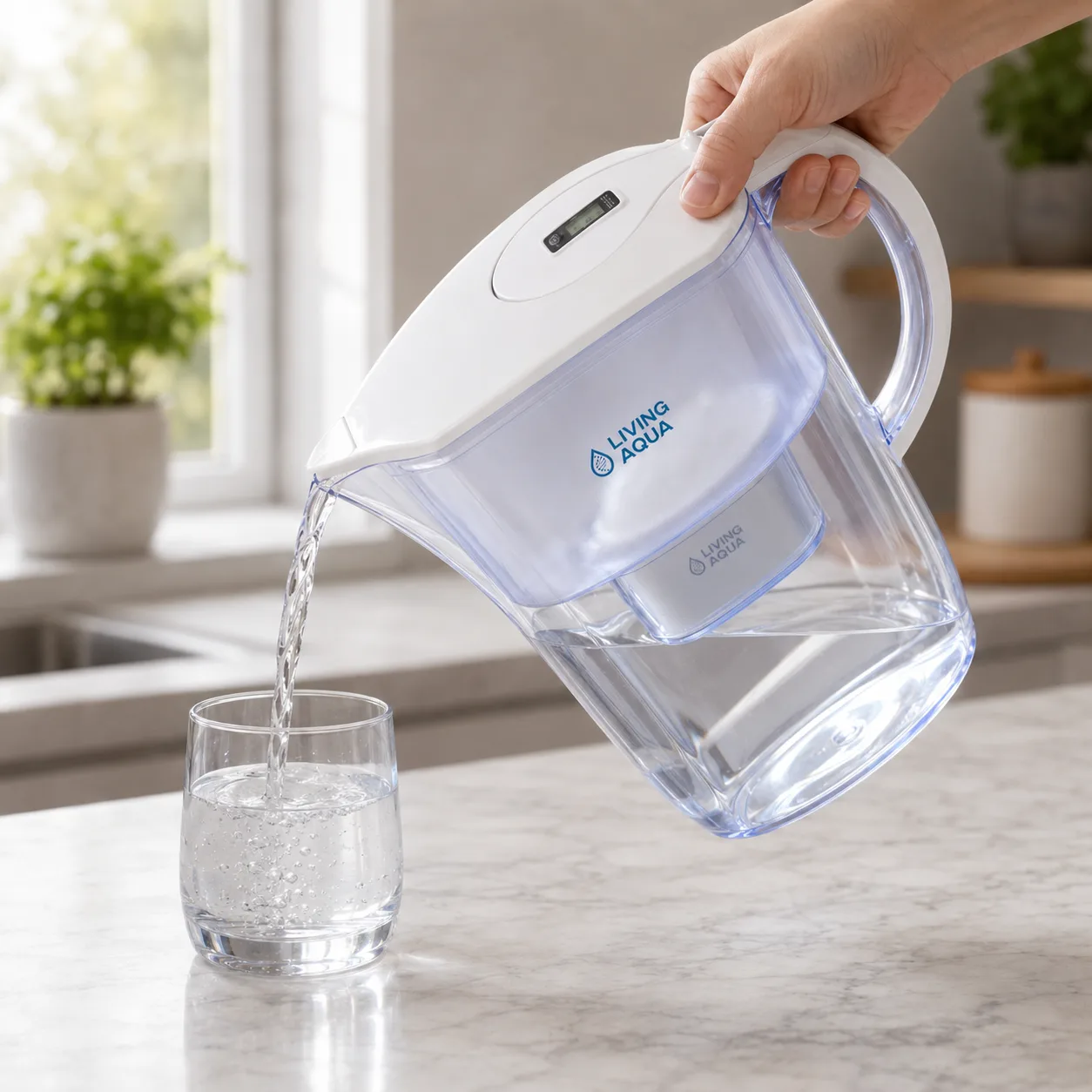
You don’t need complex systems, installation or electricity. The filter of the Living Aqua pitcher is built on Prof. Pokotylo’s magnesium–ceramic blend, which reacts with water to release hydrogen — the same kind of reaction that happens underground, where water meets magnesium-bearing rock.
 The go-to device for home
The pitcher is the go-to device for home: fill it, and the whole family drinks hydrogen-rich water. If your water is already safe to drink, Hydrogen Water Discs turn any glass or bottle into hydrogen water in 5 minutes, and each disc works 2–3 months. On the go, the Insulated Bottle keeps it with you — its wide mouth fits a disc.
Or message us on WhatsApp: +44 7350 814562
Or email us: info@living-aqua.com
Leave your name and phone number, and a specialist will call you back. No obligation.
Thank you! A specialist will call you back within one business day.
By clicking “Request a call”, you agree that Living Aqua may call or text you at the number provided about your request, including by automated means. Consent is not a condition of purchase. Msg & data rates may apply. Reply STOP to opt out. See our Privacy Policy.
Living Aqua
We’re here to helpWe usually reply within 10 minutes
Hi there! 👋
Questions about the discs or the pitcher? Choose how you’d like to talk to us.
WhatsApp Message us on WhatsApp +44 7350 814562You’re offline. Check your connection to send messages.
Thank you!
A specialist will call you back within one business day.