📋 In this article
Hydrogen water is only as good as the molecular hydrogen still dissolved in it. The short answer: drink it fresh, soon after making it rather than from a glass that has stood for hours; keep it in a closed bottle instead of an open glass; and spread it through the day as part of the water you already drink. Hydrogen is the lightest gas there is, so it escapes from water easily — a few simple habits help you avoid losing it for nothing.
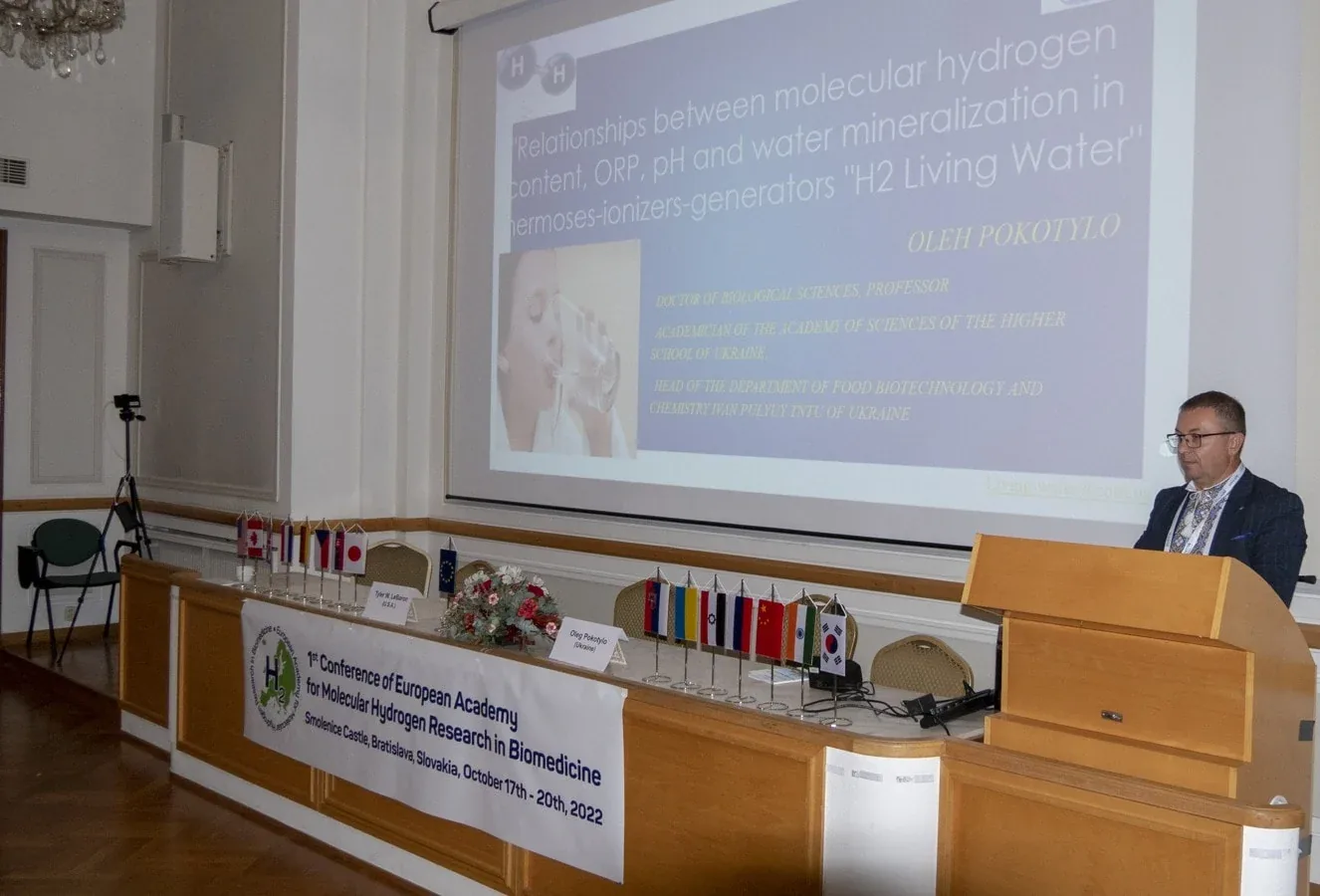
Below: when and how much to drink — based on Prof. Oleh Pokotylo’s book 5 Fundamental Postulations of Drinking Water and US guidance — how to make and store hydrogen water with Living Aqua discs or the pitcher, and the mistakes to avoid.
Why freshness matters
Hydrogen water is ordinary drinking water infused with molecular hydrogen (H₂), much like sparkling water is infused with carbon dioxide. Research interest took off in 2007, when a Japanese team reported in Nature Medicine that, in cell experiments, H₂ selectively neutralized the hydroxyl radical, the reactive oxygen species most damaging to cells, while leaving alone those the body needs (Ohsawa et al., 2007). More in What is hydrogen water.
The catch: dissolved hydrogen doesn’t stay put. In an open glass, water stays hydrogen-rich for only about an hour. Water from the Living Aqua pitcher keeps its properties for up to 5–6 hours in a closed container. And with a Living Aqua disc inside a closed bottle, the disc keeps generating hydrogen and the bottle holds it in the water for up to 12 hours.
Lab data agree. In one study, sealed bottles of hydrogen water held their level for at least 7 days, but once opened, the level dropped within an hour and further by two; the researchers advised drinking it within 2 hours of opening, with as little air in the bottle as possible (Kurokawa et al., 2015).
Your body takes hydrogen up fast, too. In a small study of five adults, breath hydrogen peaked 10–15 minutes after drinking hydrogen water, then quickly fell back to baseline; more hydrogen in the water meant a higher peak (Shimouchi et al., 2009). One more reason to prefer several fresh servings a day over one big glass left on the counter.
When to drink hydrogen water
Prof. Pokotylo’s answer to “when” is simple: throughout your waking day, from getting up to going to bed — but not evenly. He suggests drinking about 60% of your water in the first half of the day and 80% of it before 6 p.m.
A sample day
Here is the drinking schedule from his book, adapted for hydrogen water. His times assume a 6 a.m. wake-up; shift them to fit your day.
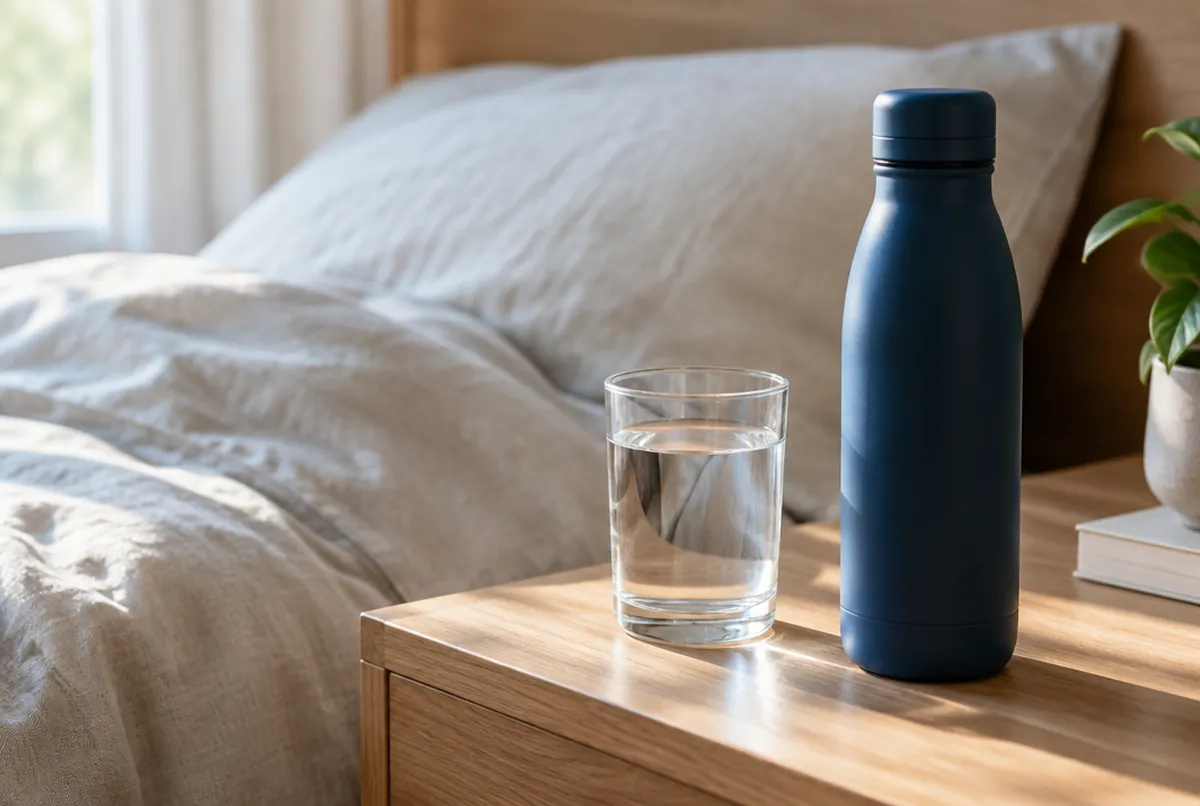
- On waking: 3–7 fl oz (100–200 mL) on an empty stomach. The book suggests keeping water by the bed; for hydrogen water, drop a disc into a closed bottle in the evening and it will be ready at your bedside.
- 15 minutes later: another 3–7 fl oz (100–200 mL).
- 30 minutes after that: a third serving — 10–20 fl oz (300–600 mL) in total before breakfast, which he suggests eating about 30 minutes later.
- Between breakfast and lunch: 3–5 fl oz (100–150 mL) about every hour.
- 30–40 minutes before lunch and before dinner: another serving.
- After dinner: 3–7 fl oz (100–200 mL) about an hour later.
That adds up to about 11 servings, or 37–74 fl oz (1.1–2.2 L) — a template, not a rule. If you keep only one part of it, make it the morning glass: it’s an easy habit that reminds you to drink for the rest of the day.
One difference in approach: the book advises against drinking water during meals, while Mayo Clinic suggests a drink of water with each meal and the CDC recommends serving water with meals. If a glass at dinner suits you, it still counts.
Around workouts
For training, the book offers a simple formula: about 13.5 fl oz (400 mL) 30 minutes before you start, a few sips — around 1.7 fl oz (50 mL) — every 15 minutes during the session, and about 13.5 fl oz (400 mL) 30 minutes after you finish.
Research on hydrogen water and exercise is early and small. In a pilot study of 10 male soccer players, blood lactate rose during heavy exercise after placebo water but not after hydrogen-rich water, and muscle strength didn’t drop in the early phase of a fatigue test (Aoki et al., 2012). In 19 healthy adults, hydrogen water taken the day before and the day of testing lowered average heart rate and breathing rate on a treadmill without changing peak performance (LeBaron et al., 2019). Both teams call for further studies, and the best dose is still being worked out. More in our article Hydrogen water and sports.
How much hydrogen water to drink
There is no official daily amount for hydrogen water. The simplest approach is to treat it as part of your daily water — replacing plain water, not adding to it.
For total water, the National Academies set adequate intakes of about 91 fl oz (2.7 L) a day for women and 125 fl oz (3.7 L) for men. That counts all beverages and food, with about 80% coming from drinks, and people who are very active or live in hot climates may need more.
Prof. Pokotylo calculates drinking water by body weight: about 0.45 fl oz per pound with low activity, 0.5 with moderate and 0.6 with high (30, 35 and 40 mL per kg). For a healthy 154 lb (70 kg) person, his example comes to about 68 fl oz (2 L) a day, or roughly eight 8-oz glasses.
What have studies used? In a four-week randomized trial, 38 healthy adults drank about 50 fl oz (1.5 L) a day of either hydrogen water or plain water. Overall antioxidant markers didn’t differ between the groups, although in participants aged 30 and older one blood measure of antioxidant capacity rose more with hydrogen water (Sim et al., 2020). It’s a reference point, not a prescription.
How to make hydrogen water with discs or the pitcher
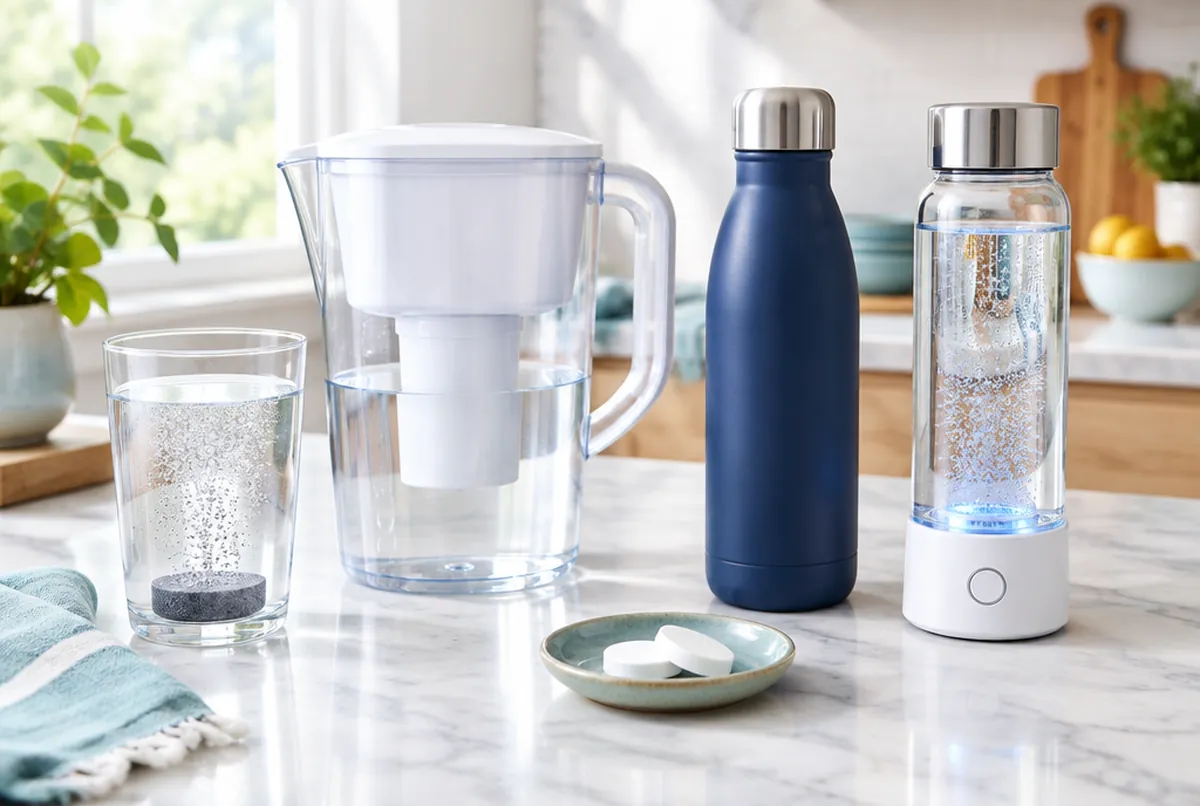
With Living Aqua Hydrogen Water Discs
- Before first use, rinse the disc under running drinking water for 20–30 seconds, soak it in water for 1 minute, then pour that water out.
- Drop it into a glass, bottle or small pitcher of clean, still drinking water — cold or room temperature. The disc isn’t a filter, so use water that’s already safe to drink: filtered, bottled or reverse-osmosis.
- Wait 5 minutes. Fine bubbles appear on the disc within 2–3 minutes — a sign the reaction has started.
- Drink it through the day, best fresh. Left in a closed bottle, the disc keeps the water hydrogen-rich for up to 12 hours.
- Rinse the disc after use and let it air-dry. Each disc lasts 2–3 months or up to 53–58 gal (200–220 L); after that it keeps working, but its output gradually declines.
The disc is 1.8 in (45 mm) across, so it fits wide-mouth bottles with a 2.2–2.4 in (55–60 mm) opening but not narrow-neck ones. See the discs.
With the Living Aqua Hydrogen-Rich Alkaline Water Pitcher
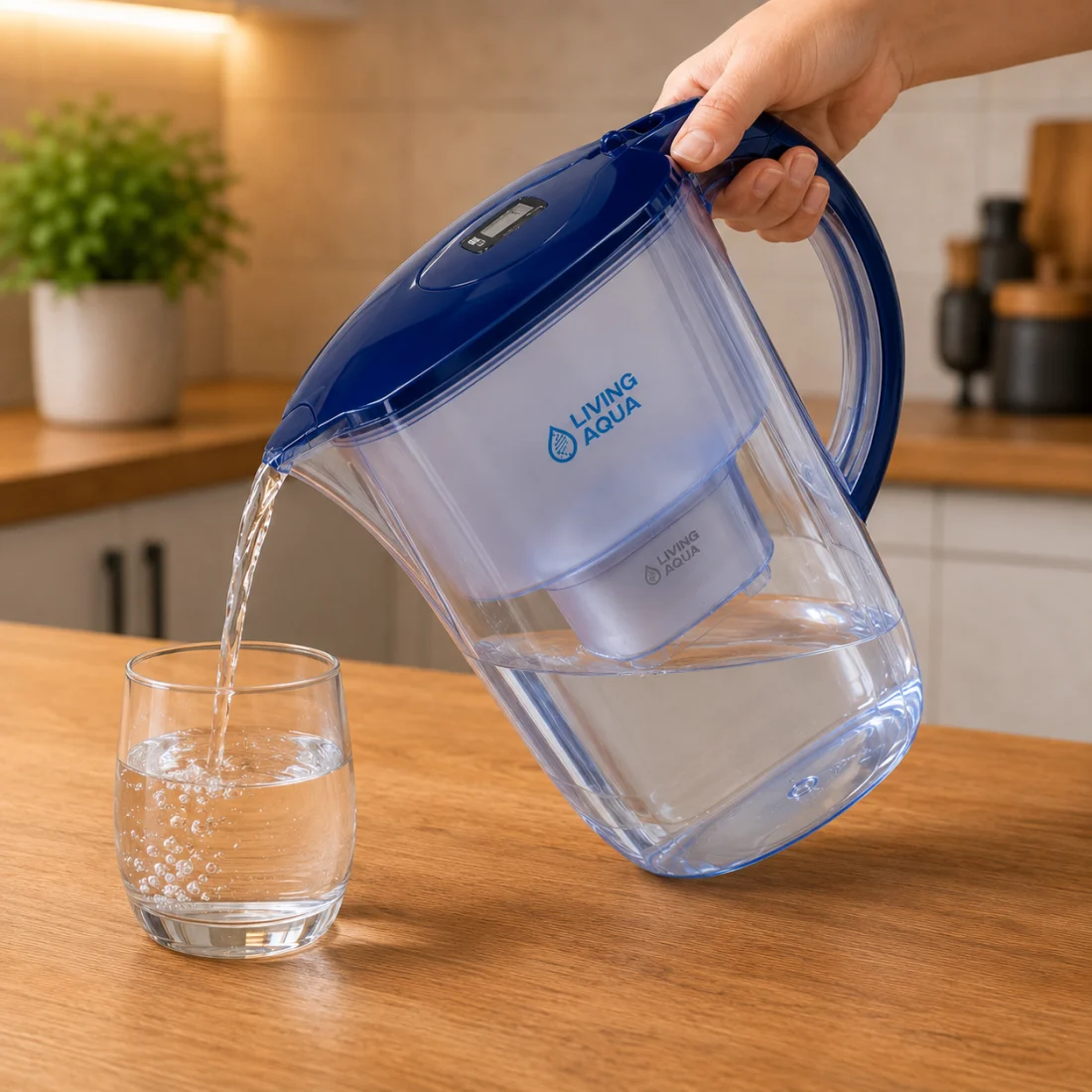
- Fill the pitcher. It holds 3.8 L (128 oz), and ordinary tap water is fine: the pitcher filters it.
- Wait about 2 minutes while the water passes through the four-stage filter, picks up minerals and takes on hydrogen — on average 0.3–0.8 ppm, depending on your source water.
- Pour and drink it fresh. To take it with you, use a bottle with a tight lid: the water keeps its properties for up to 5–6 hours in a closed container, versus about 1 hour in an open glass.
- Replace the filter every 6–8 weeks or after 300–350 L (79–92 gal) of water. Replacing it on time keeps the hydrogen level steady, so keep spare filters on hand. Before using a new filter, soak it in clean water for 3–5 minutes and pour that water out, then pour out the first pitcher after installing it.
If you drink tap water and want hydrogen water on the go, combine the two: fill your bottle from the pitcher and drop in a disc. More about the filter in How the hydrogen alkaline pitcher works.
How to store hydrogen water
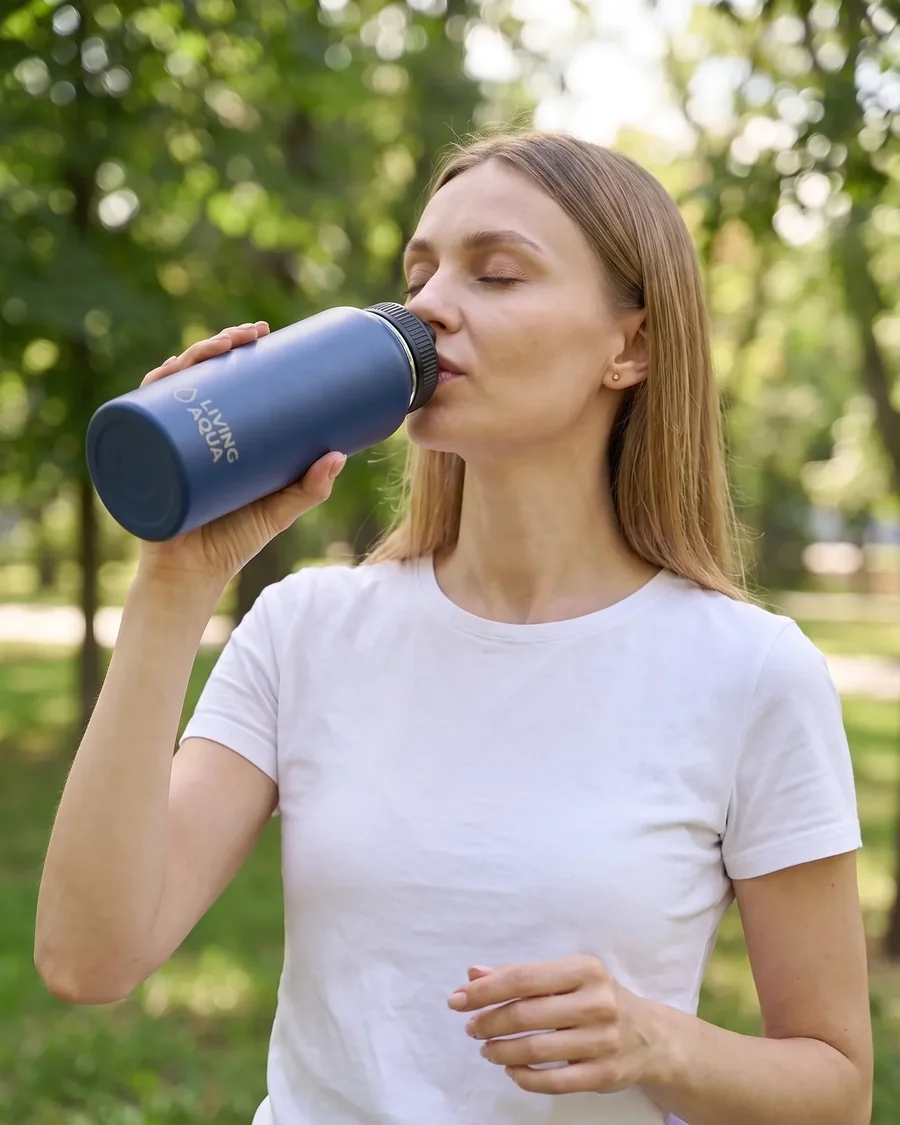
- Close it. Use a bottle with a tight lid, not an open glass or carafe.
- Fill it to the top. The less air in the bottle, the less room hydrogen has to escape into (Kurokawa et al., 2015).
- Open it as little as possible. Without a disc inside, finish an opened bottle within about 2 hours, as the researchers above advise.
- Keep it cool. Cold water holds dissolved gas better than warm water — the USGS explains the effect for oxygen, and it’s why a cold soda keeps its fizz longer. With a disc, use water no warmer than 122 °F (50 °C).
- Choose the right bottle. Glass or stainless steel with a wide mouth is easy to clean and fits the disc — like the 22 or 32 oz Living Aqua Insulated Bottle: leak-proof stainless steel with a 2.2 in (55 mm) mouth that keeps drinks cold.
Common mistakes
- Leaving a glass “for later.” An open glass stays hydrogen-rich for only about an hour.
- Putting the disc in tea, coffee, juice, milk or sparkling water. It’s designed for still drinking water only.
- Using unfiltered tap water with the disc. The disc doesn’t purify water; filter it first.
- Heating hydrogen water. Heat drives the gas out, so drink it cool or at room temperature.
- Drinking it all at once. Small, regular servings work better, and drinking far more water than your kidneys can clear is rare but can be dangerous (Mayo Clinic).
- Confusing alkaline and hydrogen water. They measure different things — see the difference between alkaline and hydrogen water.
- Treating it as medicine. Hydrogen water is part of a healthy daily routine, not a treatment.
Frequently asked questions
Is it OK to drink hydrogen water on an empty stomach?
How long does hydrogen water stay hydrogen-rich?
Can I use hydrogen water for tea or coffee?
Is hydrogen water safe to drink every day?
Key takeaways
- Fresh is best: drink hydrogen water soon after making it, not hours later from an open glass.
- Closed and full: keep it in a closed bottle with little air; without a disc inside, finish an opened bottle within about 2 hours.
- Spread it out: start before breakfast and have most of your water before 6 p.m.
- Part of your daily water, not extra: roughly 0.45–0.6 fl oz per pound of body weight (30–40 mL per kg), more in heat and during exercise.
- Right water, right schedule: clean, still, cool water; replace filters every 6–8 weeks and discs every 2–3 months.
Hydrogen water is not a substitute for medicine — it’s everyday support for your body with better water. Ready to start? Choose your product.
This article is for general information only and isn’t medical advice. If you have a health condition, ask your doctor how much and what kind of water is right for you.
Sources
- Pokotylo O. 5 Fundamental Postulations of Drinking Water. Ternopil: FOP Palianytsia V.A.; 2021. ISBN 978-617-7875-12-2.
- Ohsawa I, Ishikawa M, Takahashi K, et al. Hydrogen acts as a therapeutic antioxidant by selectively reducing cytotoxic oxygen radicals. Nature Medicine. 2007;13(6):688–694. PubMed 17486089
- Kurokawa R, Seo T, Sato B, Hirano S, Sato F. Convenient methods for ingestion of molecular hydrogen: drinking, injection, and inhalation. Medical Gas Research. 2015;5:13. PubMed 26504515
- Shimouchi A, Nose K, Yamaguchi M, Ishiguro H, Kondo T. Breath hydrogen produced by ingestion of commercial hydrogen water and milk. Biomarker Insights. 2009;4:27–32. PubMed 19652760
- Aoki K, Nakao A, Adachi T, Matsui Y, Miyakawa S. Pilot study: Effects of drinking hydrogen-rich water on muscle fatigue caused by acute exercise in elite athletes. Medical Gas Research. 2012;2:12. PubMed 22520831
- LeBaron TW, Larson AJ, Ohta S, et al. Acute supplementation with molecular hydrogen benefits submaximal exercise indices: a randomized, double-blinded, placebo-controlled crossover pilot study. Journal of Lifestyle Medicine. 2019;9(1):36–43. PubMed 30918832
- Sim M, Kim CS, Shon WJ, et al. Hydrogen-rich water reduces inflammatory responses and prevents apoptosis of peripheral blood cells in healthy adults: a randomized, double-blind, controlled trial. Scientific Reports. 2020;10:12130. PubMed 32699287
- National Academies (Institute of Medicine). “Report Sets Dietary Intake Levels for Water, Salt, and Potassium To Maintain Health and Reduce Chronic Disease Risk.” News release; 2004. nationalacademies.org
- Mayo Clinic Staff. “Water: How much should you drink every day?” Mayo Clinic; 2026. mayoclinic.org
- Centers for Disease Control and Prevention. “About Water and Healthier Drinks.” 2026. cdc.gov
- U.S. Geological Survey, Water Science School. “Dissolved Oxygen and Water.” usgs.gov
- U.S. Food and Drug Administration. GRAS Notice No. 520: Hydrogen gas. Closed November 28, 2014 (“FDA has no questions”). fda.gov
A Ukrainian manufacturer of hydrogen water devices.
Found your routine? We’ve got the device
Pitchers, discs and insulated bottles of our own making — no electricity needed, backed by lab test reports.
Read next