📋 In this article
Alkaline water is water with a pH above 7. Hydrogen water is water with molecular hydrogen gas (H₂) dissolved in it. One describes acidity, the other a dissolved gas — so water can be alkaline without any hydrogen, and hydrogen-rich without being strongly alkaline.
They get mixed up because some ways of making hydrogen water also raise the pH. Here’s what each term measures, how ORP gives hydrogen water away, what research says, and how to check your own water at home.
Alkalinity is about pH
pH shows how acidic or alkaline water is. The scale runs from 0 to 14:
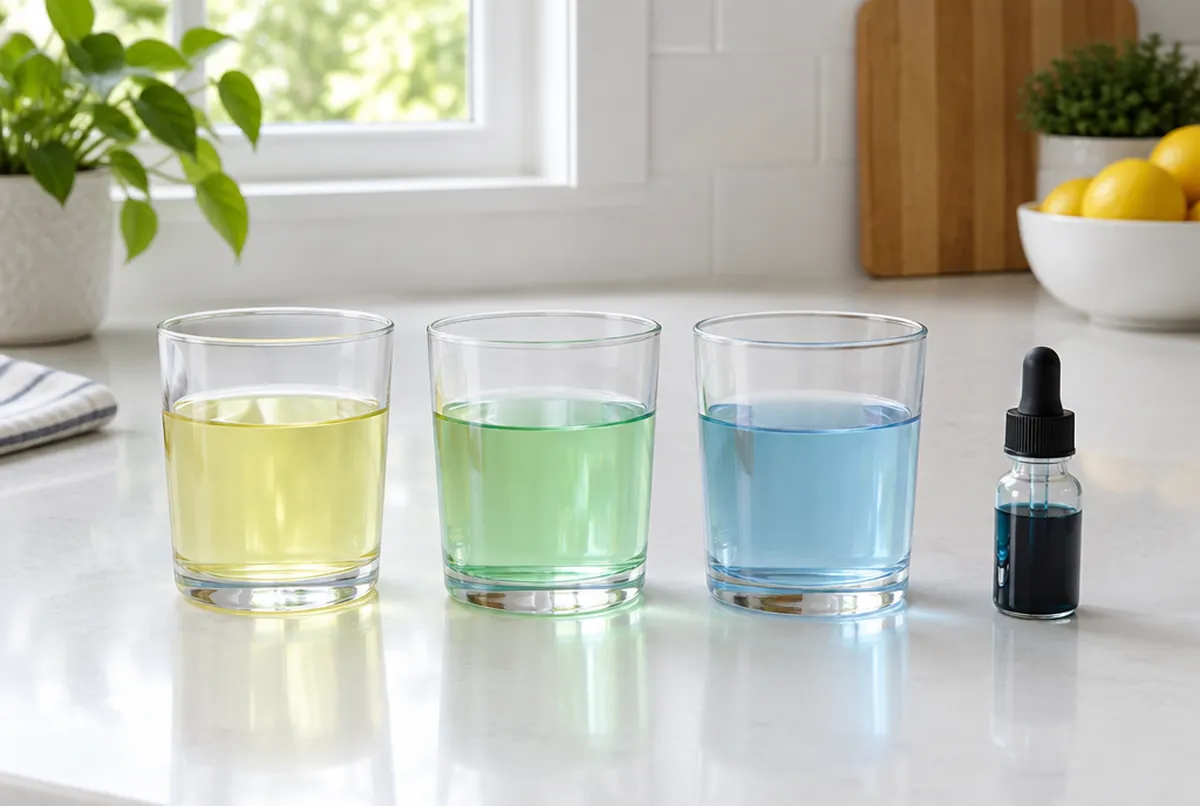
- pH 7 — neutral water;
- below 7 — acidic (sodas, coffee);
- above 7 — alkaline.
The scale is logarithmic. According to the U.S. Geological Survey, each whole number is a tenfold change, so water at pH 5 is ten times more acidic than water at pH 6.
Water with a pH of roughly 7.5–9.5 is usually called mildly alkaline. It tends to taste softer, and at the low end of that range it’s close to the pH of blood, about 7.4.
Where the pH number comes from
Water becomes alkaline in a few ways:
- Minerals. Bottled alkaline water may simply have minerals such as calcium and magnesium added, Mayo Clinic notes.
- Electrolysis. Alkaline ionizer machines split tap water into an alkaline stream and an acidic one.
- Magnesium. When magnesium metal meets water, it forms hydrogen gas and magnesium hydroxide (Mg + 2H₂O → Mg(OH)₂ + H₂). The hydroxide raises the pH; the hydrogen dissolves in the water.
For tap water, pH is mostly a technical matter. EPA recommends, but doesn’t require, pH 6.5–8.5 for public water systems — a guideline for taste, deposits and pipe corrosion rather than health. The World Health Organization hasn’t set a health-based limit for pH at all.
Here’s the key point: pH tells you nothing about hydrogen. You can make water alkaline with minerals alone and still have virtually no free H₂ in it.
Hydrogen water is about dissolved H₂
Every water molecule contains hydrogen, but in H₂O it’s tightly bound to oxygen. Hydrogen water also carries free molecular hydrogen: H₂ gas dissolved in the water, much the way carbon dioxide is dissolved in sparkling water.
How much can water hold? At room temperature and normal pressure, water tops out at about 1.6 milligrams of H₂ per liter — 1.6 parts per million (ppm), or 1,600 parts per billion (ppb). Ordinary water standing in open air holds less than a millionth of a milligram per liter. So when a test or a label gives H₂ in ppm or ppb, that’s the number that makes water hydrogen water.
It’s this dissolved hydrogen that researchers study as a selective antioxidant. In a 2007 paper in Nature Medicine, a team at Nippon Medical School in Japan reported that, in cultured cells, H₂ selectively reduced the hydroxyl radical — the most cytotoxic of the reactive oxygen species. It left other reactive oxygen species, which have useful jobs in the body, alone. We cover the basics in What is hydrogen water.
And the rule works in reverse: hydrogen content tells you nothing about pH. H₂ doesn’t break apart into ions when it dissolves, so infusing neutral water with hydrogen gas leaves it neutral.
Hydrogen doesn’t stay put
H₂ is the smallest and lightest molecule there is, and it gradually escapes from water. That’s why hydrogen water is best made at home and drunk fresh: in a closed container it keeps its properties for up to 5–6 hours, in an open glass for about an hour.
ORP: the reading that gives hydrogen water away
How can you tell whether water contains free hydrogen without a lab? The handiest indicator is oxidation-reduction potential (ORP), measured in millivolts (mV). A positive ORP means the water tends to take electrons (it oxidizes); a negative ORP means it tends to give them up (it reduces). Dissolved hydrogen is a reducing agent, so it pulls the reading below zero, while chlorinated tap water reads positive.
| Water | pH | ORP |
|---|---|---|
| Tap | ~7 | +200 to +400 mV |
| Alkaline mineral | 8–9 | often positive |
| Hydrogen (made with magnesium) | 7.5–9.5 | −150 to −500 mV |
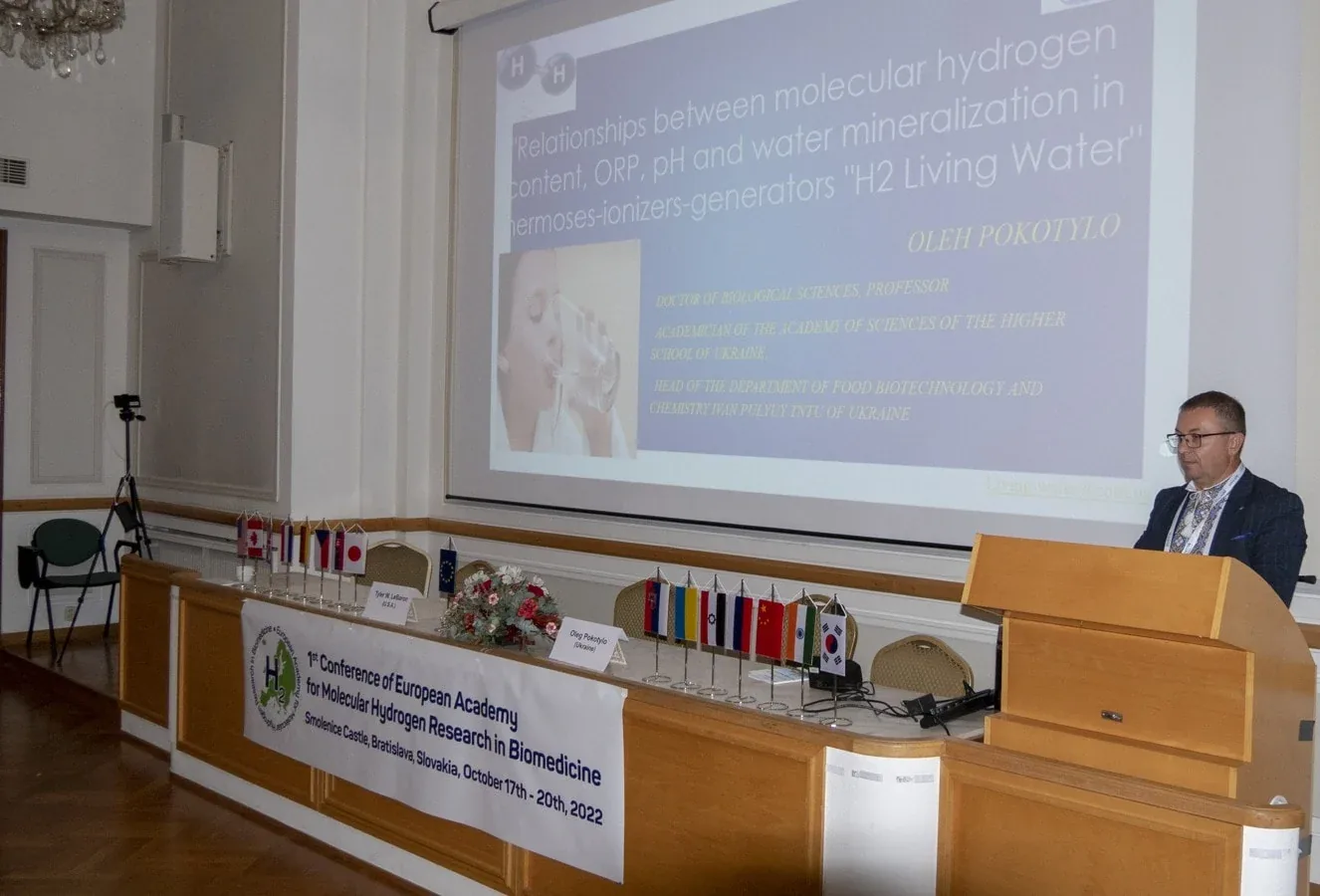
Look at the middle row: bottled alkaline water can have a high pH and still a positive ORP — no reducing properties at all. Prof. Oleh Pokotylo — Professor, Academician, Doctor of Biological Sciences — saw exactly this when he tested six popular bottled waters. All were mildly alkaline, at pH 7.6–8.1, and all read between +211 and +250 mV.
One caveat worth knowing
ORP also shifts with pH, by roughly 60 mV per unit, as Prof. Pokotylo notes. And extra hydrogen lowers it only gradually: ten times more H₂ moves the reading about as much as half a pH unit does. So a negative ORP shows that hydrogen is present, not how much. Our article on oxidation-reduction potential goes deeper.
Alkaline vs. hydrogen water side by side
| Alkaline water | Hydrogen water | |
|---|---|---|
| Defined by | pH above 7 | Dissolved H₂ gas |
| Measured in | pH units | ppm or ppb of H₂ |
| Typical ORP | Often positive | Negative |
| Home test | pH drops, strips or meter | H₂ test drops; ORP as a quick hint |
- Alkaline water = higher pH. It’s about acid–base balance and taste.
- Hydrogen water = dissolved H₂ plus a negative ORP. It’s about the hydrogen that researchers study as an antioxidant.
- One doesn’t guarantee the other: alkaline water isn’t necessarily hydrogen water, and hydrogen water isn’t necessarily strongly alkaline.
Why the two get confused
Research on “alkaline ionized” water from electrolysis machines began in Japan as early as 1931. That water is alkaline, low in oxygen, rich in hydrogen and negative in ORP all at once, so its effects were credited to the pH, to “microclusters” or to “free electrons.” A 2022 review concluded that dissolved H₂ was the only agent behind both the negative ORP and the effects seen in studies. Researchers were making similar water with magnesium by 2004, before anyone knew hydrogen was the key.
What research says — and doesn’t
Alkaline water
Mayo Clinic’s answer is direct: for most people, alkaline water is not better than plain water, and more research is needed to back the claims made for it. Chemistry explains part of the reason. The body keeps its internal pH within about 7.35–7.45 using built-in compensating mechanisms. And alkaline water carries very little actual “alkali”: by one estimate, a teaspoon of baking soda can neutralize as much acid as about 475 gallons (1,800 L) of pH 9.5 water.
Prof. Pokotylo makes a related point about safety: alkaline water’s buffering capacity is so small that a liter puts only a tiny alkaline load on the body. Where naturally alkaline spring water is praised, researchers credit its minerals — calcium, magnesium and trace elements — rather than the pH, which fits Prof. Pokotylo’s emphasis on mineralized water.
Hydrogen water
Molecular hydrogen is a younger field. A 2015 review counted 321 original articles published since 2007; about three-quarters were studies in mice and rats, with human trials growing every year. Research suggests H₂ may support the body’s own antioxidant defenses, but it’s still being studied.
Prof. Pokotylo’s benchmarks
In 5 Fundamental Postulations of Drinking Water (2021), Prof. Pokotylo sets out parameters that good everyday water should meet at once. Among them:
- lightly mineralized: 100–500 mg/L;
- negative ORP: −100 to −300 mV;
- dissolved molecular hydrogen: 0.4–0.8 ppm.
None of them says “the higher the pH, the better”: what sets hydrogen water apart is the dissolved H₂ and the negative ORP that comes with it.
Common myths
“Alkaline” and “hydrogen” mean the same thing. They’re separate properties. Bottled alkaline water may get its pH from added minerals alone, and unless hydrogen was added, it holds virtually none.
The higher the pH, the better. Not so. EPA notes that high-pH water can taste like soda and feel slippery. Mayo Clinic flags safety concerns especially above pH 9.8, and in Japan and Korea, rules for alkaline water ionizers cap drinking water at pH 9.8. Raising the pH also adds no hydrogen.
How to test your water — and get both at home
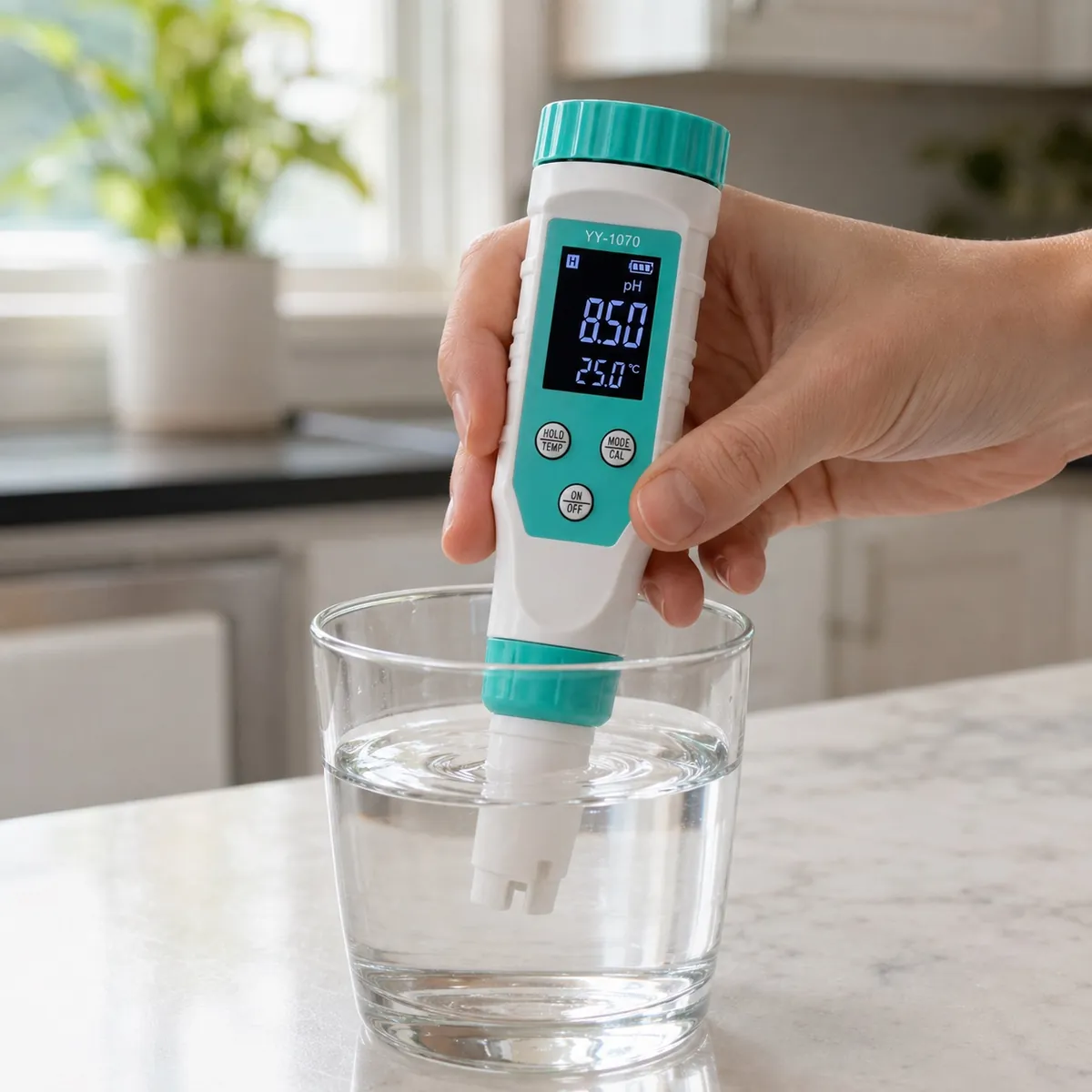
Testing at home
You can check all three properties with inexpensive tools:
- pH: test drops or strips give a rough reading; a pocket pH meter is more precise.
- ORP: a pen-style ORP meter shows whether the reading is positive or negative. Measure fresh water and let the number settle; the U.S. Geological Survey notes that readings can take longer to stabilize when a probe moves from ordinary water into reducing water.
- Hydrogen: hydrogen test drops (a redox titration reagent) estimate dissolved H₂ in ppm. Researchers describe these reagents as less accurate than lab methods but useful, and advise against relying on ORP-based hydrogen meters.
Test your tap water first, then the treated water, with the same tools, so you compare like with like.
Making it with Living Aqua
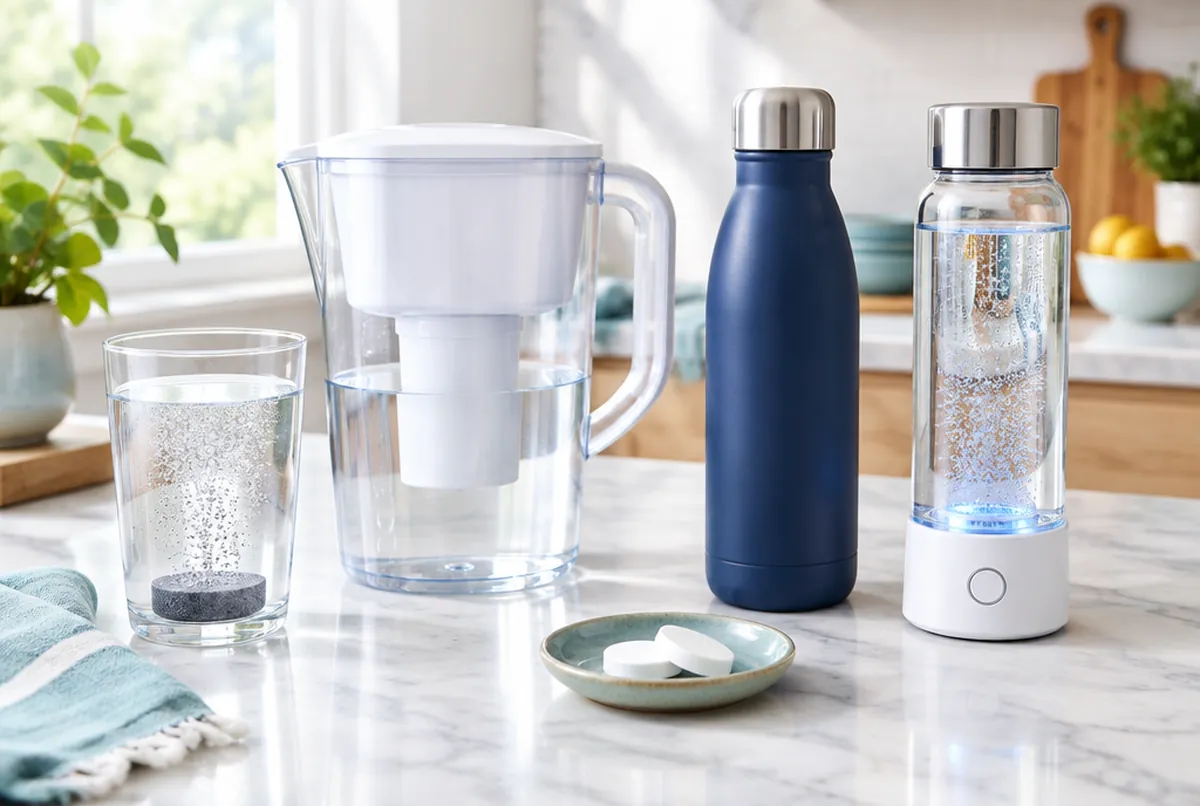
Our pitcher filter and discs both use a magnesium–ceramic mineral blend developed by Prof. Pokotylo, so they raise pH and add hydrogen in one step, with no electricity:
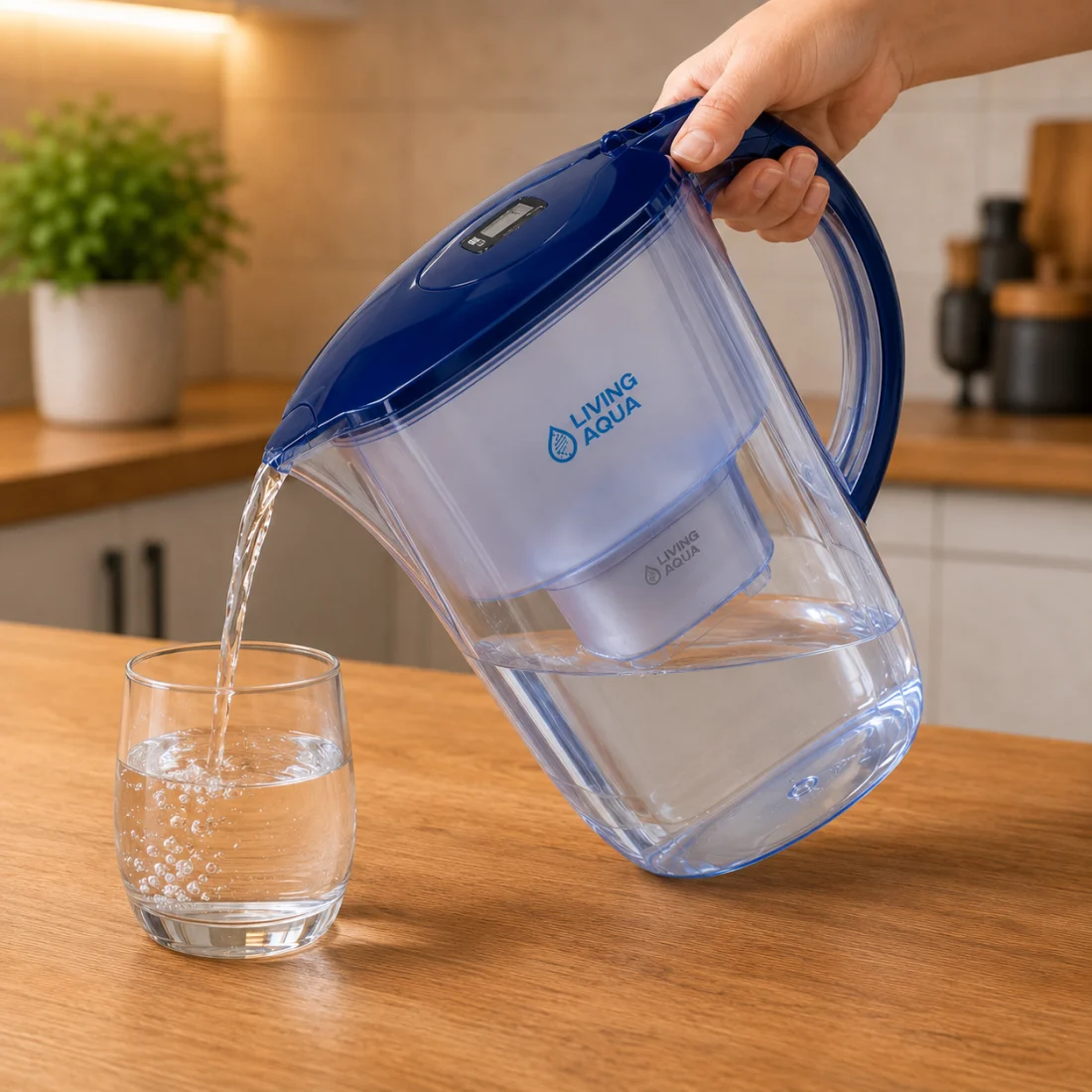
- Living Aqua Hydrogen-Rich Alkaline Water Pitcher filters tap water in about 2 minutes. Typical readings: pH 9.0 · H₂ 0.6 ppm · ORP −300 mV.
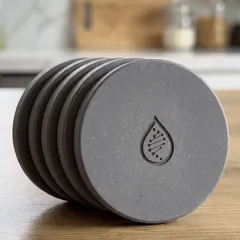
- Living Aqua Hydrogen Water Discs go into still water that’s already safe to drink (a disc isn’t a filter). The water is ready in 5 minutes, typically at pH 7.5–9.0, depending on the source water, with ORP on average down to −300 mV and hydrogen up to 1,000 ppb (1 ppm).
Exact numbers depend on your water, so the tests above are the best way to see what you get. You can browse all Living Aqua products to compare formats.
Frequently asked questions
Is alkaline water the same as hydrogen water?
Can hydrogen water be neutral instead of alkaline?
Does bottled alkaline water contain hydrogen?
How can I tell if my water has hydrogen in it?
Which matters more, pH or hydrogen?
Key takeaways
- Alkaline water is about pH; hydrogen water is about dissolved H₂. One doesn’t guarantee the other.
- A negative ORP is the quick sign that hydrogen is present; a hydrogen test tells you how much.
- Evidence for alkalinity alone is thin; research focuses on molecular hydrogen, which is still being studied.
- Magnesium-based methods give you mildly alkaline water, dissolved H₂ and a negative ORP in one glass.
Next time you see “alkaline water” on a label, ask two questions: what is its ORP, and how much dissolved hydrogen does it contain? If there’s no answer, it’s simply water with a higher pH. If you’d like all three properties at home, see how Living Aqua makes it easy.
This article is for general information only and isn’t medical advice. If you have a health condition, ask your doctor how much and what kind of water is right for you.
Sources
- Pokotylo O. 5 Fundamental Postulations of Drinking Water. Ternopil, 2021.
- U.S. Geological Survey. “pH and Water.” Water Science School. usgs.gov
- U.S. Environmental Protection Agency. “Secondary Drinking Water Standards: Guidance for Nuisance Chemicals.” epa.gov
- World Health Organization. “pH in Drinking-water.” Background document WHO/SDE/WSH/07.01/1, 2007. who.int
- Mayo Clinic Staff. “Alkaline water: Better than plain water?” Mayo Clinic, 2025. mayoclinic.org
- Hopkins E, Sanvictores T, Sharma S. “Physiology, Acid Base Balance.” StatPearls, 2022. PubMed 29939584
- Ohsawa I, Ishikawa M, Takahashi K, et al. “Hydrogen acts as a therapeutic antioxidant by selectively reducing cytotoxic oxygen radicals.” Nature Medicine, 2007;13(6):688–694. PubMed 17486089
- Ichihara M, Sobue S, Ito M, et al. “Beneficial biological effects and the underlying mechanisms of molecular hydrogen — comprehensive review of 321 original articles.” Medical Gas Research, 2015;5:12. PubMed 26483953
- LeBaron TW, Sharpe R, Ohno K. “Electrolyzed-reduced water: review I. Molecular hydrogen is the exclusive agent responsible for the therapeutic effects.” International Journal of Molecular Sciences, 2022;23(23):14750. PubMed 36499079
- LeBaron TW, Sharpe R, Ohno K. “Electrolyzed-reduced water: review II. Safety concerns and effectiveness as a source of hydrogen water.” International Journal of Molecular Sciences, 2022;23(23):14508. PubMed 36498838
A Ukrainian manufacturer of hydrogen water devices.
Found your routine? We’ve got the device
Pitchers, discs and insulated bottles of our own making — no electricity needed, backed by lab test reports.
Read next