📋 In this article
ORP stands for oxidation-reduction potential — or, more simply, the “charge” of water. It’s measured in millivolts (mV) and shows whether water tends to take electrons from other substances or give them up. Most tap and bottled water reads positive; water with dissolved molecular hydrogen reads negative. That minus sign is the quickest way to tell hydrogen water from ordinary or merely alkaline water.
Below we explain what ORP measures, why a negative reading matters, what it can’t tell you, and how to check it yourself.
What ORP actually measures
Oxidation and reduction in plain English
Oxidation means losing electrons; reduction means gaining them. The two always happen together: when one substance gives electrons up, another takes them. A rusting nail is an everyday example of oxidation.
Water carries dissolved substances that lean one way or the other. Oxygen and chlorine are oxidizers: they pull electrons toward themselves. Hydrogen gas and antioxidants such as vitamin C are reducers: they tend to give electrons away. ORP sums up that balance in a single number.
How an ORP meter works
An ORP probe pairs a platinum electrode with a reference electrode, usually silver/silver chloride, and measures the voltage between them in the water. Positive values mean oxidizing conditions; negative values mean reducing ones.
The same measurement is used far beyond drinking water. The U.S. Geological Survey has a field method for measuring it in natural waters such as groundwater, and the food industry uses ORP as a rapid check on how strongly chlorinated wash water can kill bacteria.
Positive vs. negative ORP
- Positive ORP — the water takes electrons (it oxidizes). Most tap and bottled water is like this.
- Negative ORP — the water gives up electrons (it reduces). This is the reading typical of hydrogen water.
Why is tap water positive? Part of the answer is what keeps it safe. Chlorine-based disinfectants are strong oxidizers, and chlorinated water reads positive. When University of Michigan researchers placed ORP sensors under kitchen sinks in five homes, ORP in houses with free chlorine fell after water sat in the pipes overnight, as the chlorine decayed. A positive ORP in tap water is normal, not a warning sign.
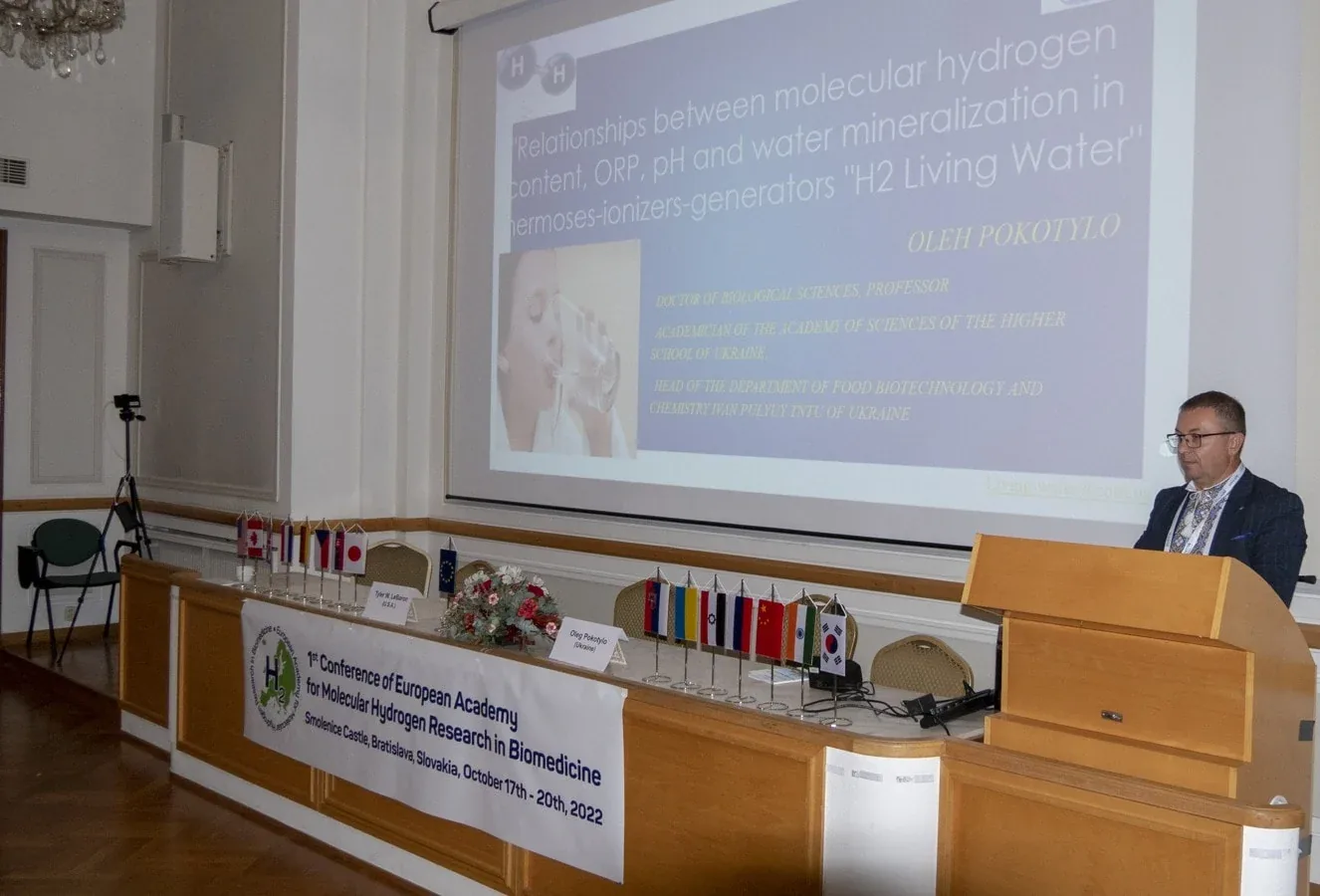
Bottled water usually reads positive too. In tests by Prof. Oleh Pokotylo — Professor, Academician, Doctor of Biological Sciences — six popular bottled waters measured +211 to +250 mV.
Why a negative ORP matters: the body’s side
Prof. Pokotylo’s main argument, in 5 Fundamental Postulations of Drinking Water (2021), is about matching. He writes that the body’s internal fluids — blood, lymph and the fluid around cells — have a negative redox potential of roughly −50 to −150 mV (elsewhere he gives −70 to −200 mV, depending on the tissue). Ordinary drinking water, by contrast, sits at +100 to +400 mV. In his view, water with a negative ORP is closer to the body’s own environment, so the body spends less energy bringing it into line.
Biochemistry research points the same way. A 2022 review notes that biological fluids are generally reductive. Cell biologists who gauge a cell’s internal balance through glutathione, its most abundant redox pair, estimate values of roughly −170 to −240 mV, depending on what the cell is doing.
To be fair, a glass of water and the inside of a cell are measured differently, so the comparison is a helpful picture rather than an exact equation. What researchers actually study is the substance that makes hydrogen water negative in the first place: molecular hydrogen.
Free radicals and antioxidants
Free radicals are molecules with an unpaired electron. They react by grabbing electrons from other molecules, and the body produces them all the time — some of them do useful signaling work. Antioxidants are reducers: they can give up electrons and stop that grabbing. That’s why reducing, electron-donating water interests researchers.
Where hydrogen comes in
Dissolved molecular hydrogen is a reducing agent, so it pushes ORP into negative territory. According to a 2022 review, H₂ is exactly what makes alkaline ionized water read negative, and the Nernst equation chemists use explains it: more hydrogen and a higher pH both push the reading down. Prof. Pokotylo describes the same inverse link — the more molecular hydrogen in water, the more negative its ORP.
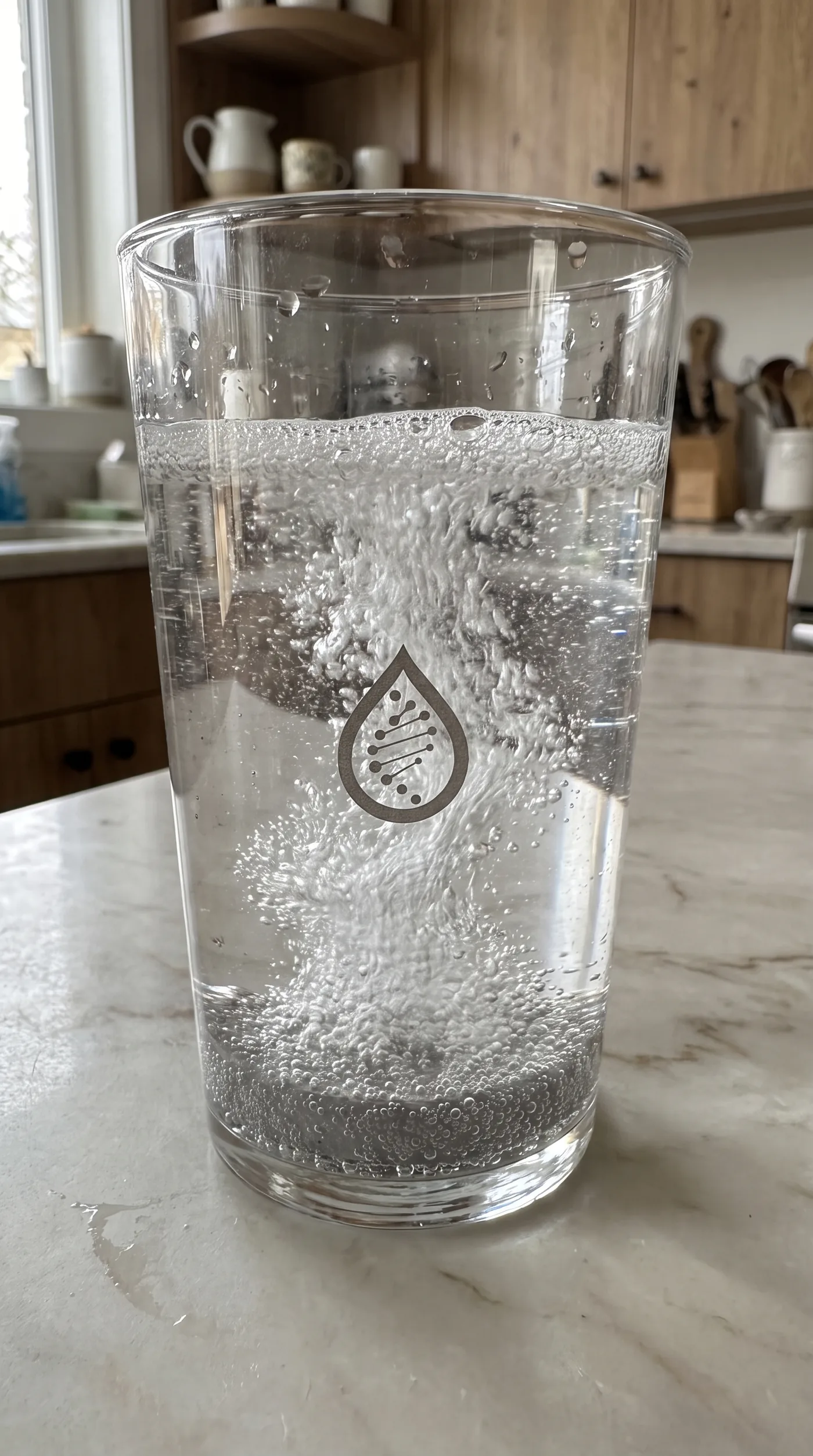
Hydrogen is also a gentle reducer. In a 2014 review, Shigeo Ohta of Nippon Medical School described H₂ as reacting with strong oxidants such as the hydroxyl radical while being mild enough not to disturb the body’s normal metabolic redox reactions or signaling. His group’s 2007 study in Nature Medicine found that, in cultured cells, H₂ selectively reduced the hydroxyl radical and left other reactive oxygen species alone.
What the numbers look like
| Type of water | Approximate ORP |
|---|---|
| Tap | +200 to +400 mV |
| Bottled | +100 to +300 mV |
| Hydrogen | −150 to −500 mV |
How fast water turns negative
Quickly. In Prof. Pokotylo’s experiment, the same six bottled waters were kept in contact with magnesium. All of them turned negative within 30 minutes (−110 to −233 mV), and the change was steepest in that first half hour. Lab tests of the Living Aqua disc show the same pattern: ORP dropped from +263 mV to negative values within minutes.
ORP is a quick signal, not a hydrogen meter
Here’s the honest nuance: ORP depends on more than hydrogen.
- pH. The reading shifts by roughly 60 mV per pH unit, as Prof. Pokotylo also notes, so more alkaline water reads somewhat lower even before any hydrogen is added.
- The amount of hydrogen. The effect is logarithmic: ten times more H₂ lowers ORP about as much as a half-unit rise in pH. That’s why a 2022 review concluded that ORP can show hydrogen is present but can’t estimate how much, and advised against ORP-based hydrogen meters.
- The meter itself. Probes differ in their reference electrodes and need time to settle. The USGS method waits for a stable reading (within ±5 mV), notes that stabilizing can take longer when moving between oxidizing and reducing water, and cautions that readings show trends rather than exact equilibrium values. Prof. Pokotylo likewise notes that readings depend on the ORP meter.
So treat ORP as a quick check: a clearly negative reading in fresh water is a good sign that hydrogen is there. To know the concentration, measure H₂ directly, in ppm or ppb.
How to measure ORP at home
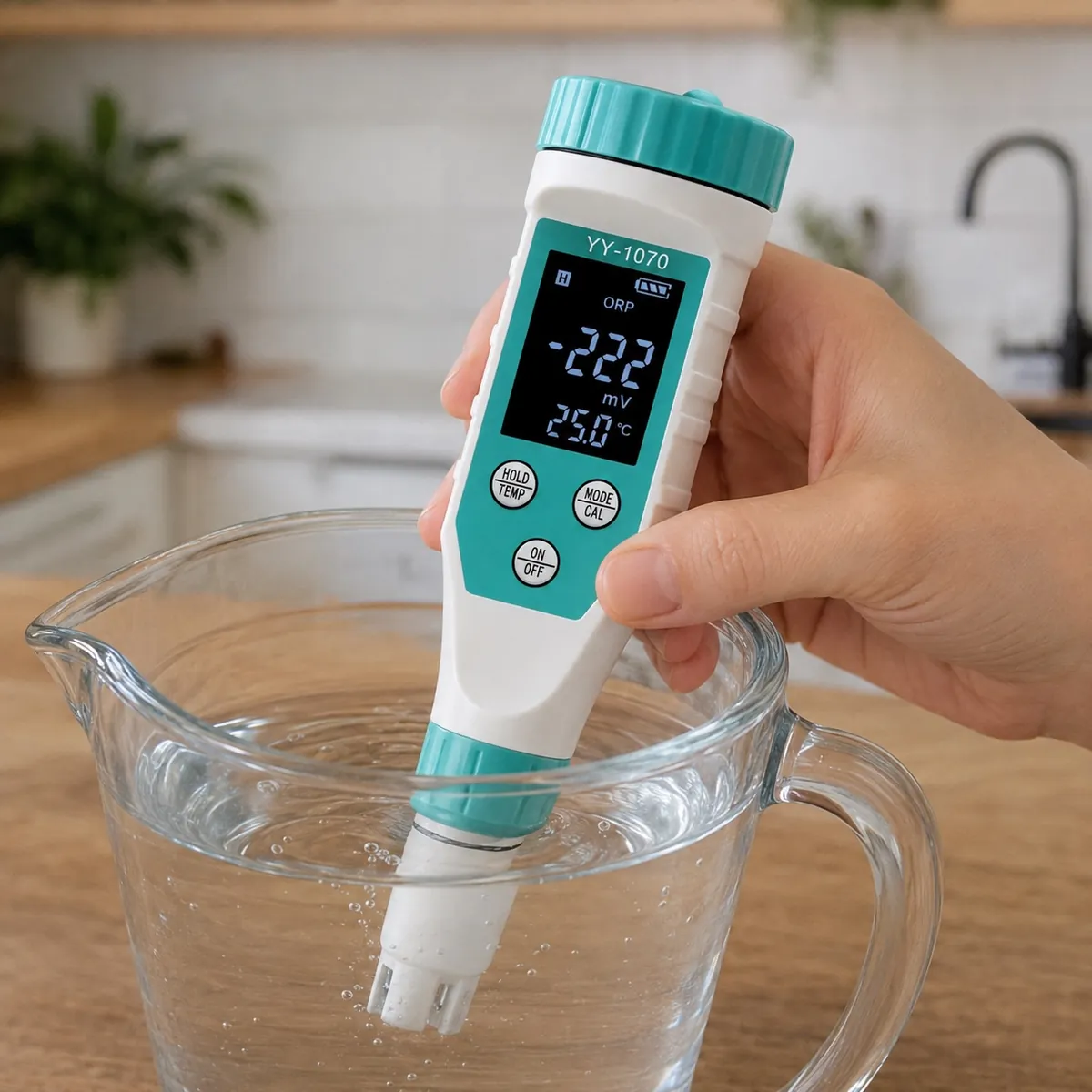
- Get a pen-style ORP meter and check it with the test solution its maker recommends.
- Rinse the probe with the water you’re about to test.
- Test fresh water right away. Hydrogen escapes over time: in a closed container, hydrogen water keeps its properties for up to 5–6 hours; in an open glass, about an hour.
- Hold the probe still and wait until the number stops drifting. Moving from tap water to hydrogen water, the reading can take a while to settle.
- Compare like with like. Measure your tap water first, then the treated water, with the same meter.
To check the hydrogen itself, use hydrogen test drops, a redox titration reagent that gives a result in ppm. Researchers describe these reagents as less accurate than lab methods but useful.
What to expect with Living Aqua
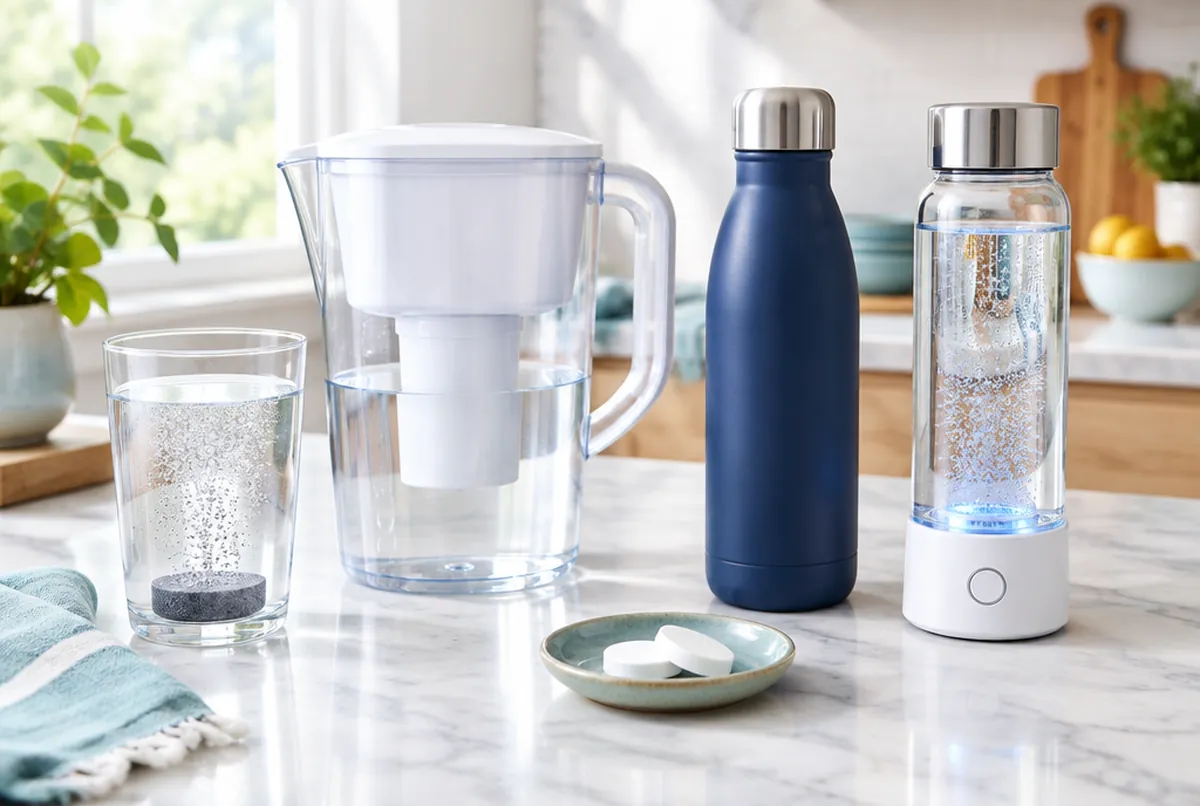
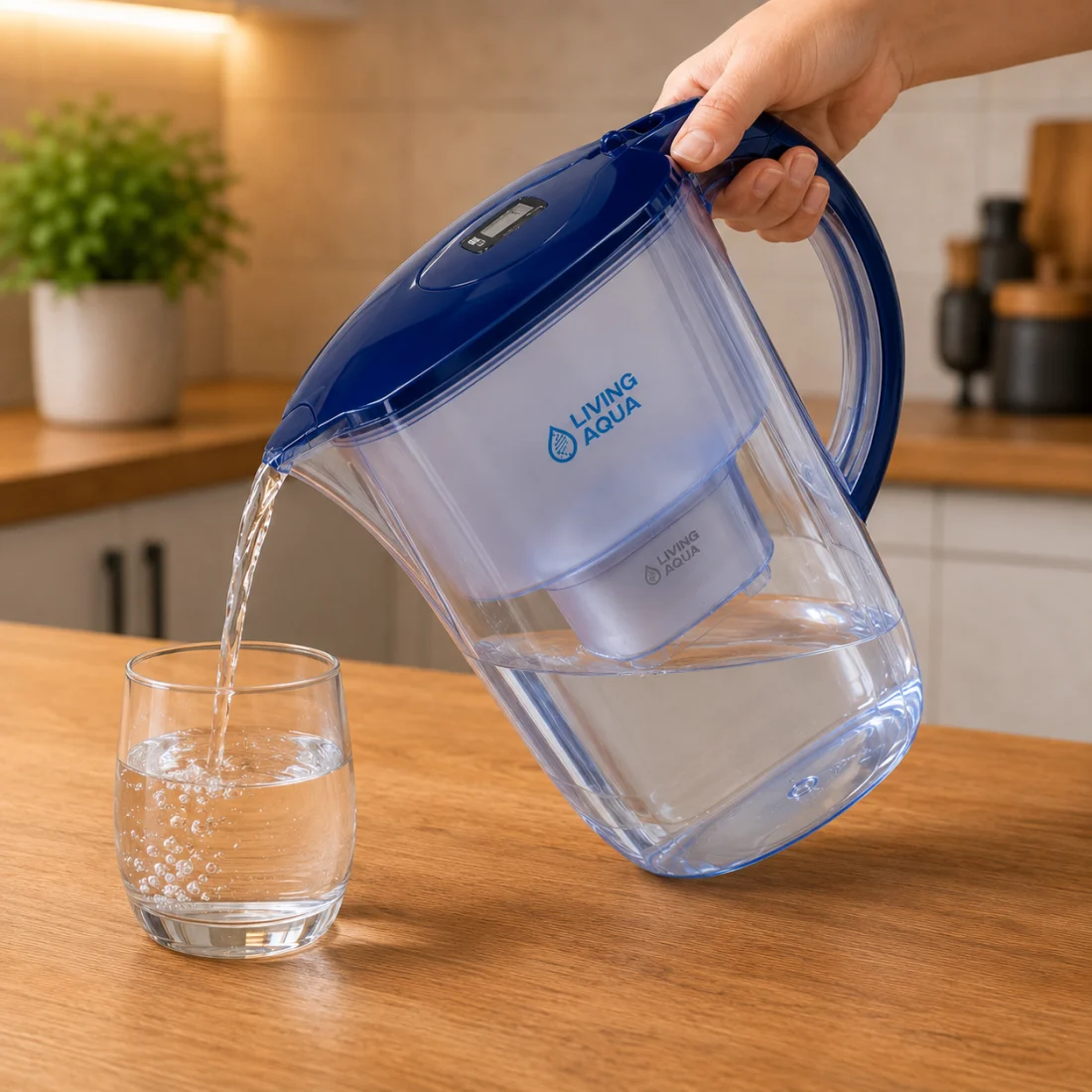
- Living Aqua Hydrogen-Rich Alkaline Water Pitcher: the filter works in about 2 minutes, and typical readings are pH 9.0 · H₂ 0.6 ppm · ORP −300 mV. How the hydrogen alkaline pitcher works explains what happens inside the filter.
- Living Aqua Hydrogen Water Discs: in still water, ORP drops on average to −300 mV, with peaks of −500 mV. Fine bubbles on the disc within 2–3 minutes are a sign the reaction has started.
A negative ORP is also the main thing that sets hydrogen water apart from plain alkaline water. More on that in Alkaline water and hydrogen water: what’s the difference.
Common ORP myths
“Negative is healthy, positive is harmful.” Too simple. Researchers who reviewed the idea call it reasonable but faulty: what matters is which substance moves the reading. Tap water reads positive partly because of the disinfectant that keeps it safe. In hydrogen water, the minus sign matters because it signals dissolved H₂.
“The more negative, the more hydrogen.” Only roughly. pH, the meter and timing all move the number, so two waters with the same amount of H₂ can read differently.
“Alkaline water always has a negative ORP.” No. The mildly alkaline bottled waters (pH 7.6–8.1) in Prof. Pokotylo’s tests all read positive.
Frequently asked questions
What is a good ORP for drinking water?
Why does my tap water have a positive ORP?
Does a negative ORP prove there is hydrogen in the water?
How long does water keep a negative ORP?
Why do two ORP meters give different readings?
Is ORP the same as pH?
Key takeaways
- ORP shows, in millivolts, whether water tends to take electrons (positive) or give them up (negative).
- Tap and bottled water usually read positive; water with dissolved hydrogen reads negative.
- Prof. Pokotylo argues that negative-ORP water is closer to the body’s internal environment; biochemistry research also describes body fluids as generally reducing.
- ORP is a fast sign that hydrogen is present, not a measure of how much. Measure H₂ directly for that.
If you’d like to see a negative ORP in your own glass, explore Living Aqua products — and test the result yourself.
This article is for general information only and isn’t medical advice. If you have a health condition, ask your doctor how much and what kind of water is right for you.
Sources
- Pokotylo O. 5 Fundamental Postulations of Drinking Water. Ternopil, 2021.
- LeBaron TW, Sharpe R, Ohno K. “Electrolyzed-reduced water: review I. Molecular hydrogen is the exclusive agent responsible for the therapeutic effects.” International Journal of Molecular Sciences, 2022;23(23):14750. PubMed 36499079
- LeBaron TW, Sharpe R, Ohno K. “Electrolyzed-reduced water: review II. Safety concerns and effectiveness as a source of hydrogen water.” International Journal of Molecular Sciences, 2022;23(23):14508. PubMed 36498838
- Nordstrom DK, Wilde FD. “Reduction-oxidation potential (electrode method).” National Field Manual for the Collection of Water-Quality Data, Chapter A6, Section 6.5, version 1.2. U.S. Geological Survey, 2005. usgs.gov
- Gongora K, Vankerschaver J, Sampers I, Van Haute S. “The influence of pH on the efficacy of oxidation-reduction potential (ORP) to predict chlorine disinfection of surrogate bacteria, Escherichia coli O157:H7 and Listeria monocytogenes in oxidant demand free conditions and fresh produce wash water.” Food Microbiology, 2024;121:104516. PubMed 38637078
- Martinez Paz EF, Raskin L, Wigginton KR, Kerkez B. “Toward the autonomous flushing of building plumbing: characterizing oxidation-reduction potential and temperature sensor dynamics.” Water Research, 2024;251:121098. PubMed 38219686
- Schafer FQ, Buettner GR. “Redox environment of the cell as viewed through the redox state of the glutathione disulfide/glutathione couple.” Free Radical Biology and Medicine, 2001;30(11):1191–1212. PubMed 11368918
- Ohta S. “Molecular hydrogen as a preventive and therapeutic medical gas: initiation, development and potential of hydrogen medicine.” Pharmacology & Therapeutics, 2014;144(1):1–11. PubMed 24769081
- Ohsawa I, Ishikawa M, Takahashi K, et al. “Hydrogen acts as a therapeutic antioxidant by selectively reducing cytotoxic oxygen radicals.” Nature Medicine, 2007;13(6):688–694. PubMed 17486089
- U.S. Environmental Protection Agency. “National Primary Drinking Water Regulations.” epa.gov
- U.S. Environmental Protection Agency. “Secondary Drinking Water Standards: Guidance for Nuisance Chemicals.” epa.gov
A Ukrainian manufacturer of hydrogen water devices.
Found your routine? We’ve got the device
Pitchers, discs and insulated bottles of our own making — no electricity needed, backed by lab test reports.
Read next